Skinning Elk: On the
Ground or Hanging
Skinning elk is probably the easiest part of butchering an animal. Once you’ve gutted your elk, or decided to use the gutless method, you’re ready for skinning. Everyone has their own peculiar way of skinning big game, but the idea is to get the hide off without getting dirt and hair on the meat.
There is a good video at the bottom of this page of the gutless field dressing and quartering process provided by Dax McCarty of Wagonhound Outfitters.
Secondly, most people want to get it done fast and efficiently without gouging the meat with a blade. Some like to keep from cutting through the hide, so they can use it for something.
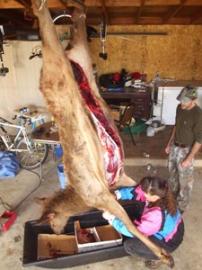
For skinning elk that are hanging, gravity simply plays a different role. If there are horns, most people prefer skinning elk hanging from its head. If it’s a cow, most prefer to tie a branch, pole, bar or lift hooks to the back legs between the tendon and leg bone just above the lowest joint. (Be careful not to cut the tendon.) The bar can be inserted through a hole cut between the bone and large tendon.
Skinning on the Ground
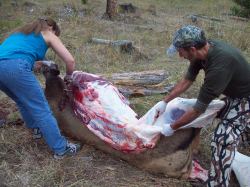
When skinning elk on the ground, you have to skin one side and then flip the elk over and do the same on the other. You might as well remove the legs from the first side before flipping it over.
Put the quarters in game bags immediately to keep them clean. If you're by yourself and can't do that, stretch the loose skin out for the skinned side to put it on, or use a tarp or table cloth to put the meat on. If you can put the quarters right in a bag, it will keep them clean and keep the flies and bees off.
Related topics available:
Moving a Whole Elk
Game Hauler Review
Field Dressing Elk
Gutless Field Dressing
Quartering Elk in the Field
Deboning Elk in the Field
Cooling Big Game in the Field
Game Meat Processing: Bill's True Story
Caping An Elk for a Shoulder Mount
Elk Hunting With Horses
Getting Elk Meat Home Easier
My family has grown comfortable skinning elk on the ground, but We still hang it up to skin and quarter it if we get an elk home whole (rare). Hanging makes it easier to cut meat off the bones, but that can be done relatively easily on the ground as well.
To hang it at home, we use a singletree with hooks that a friend made for us. We lift it with a simple chain hoist secured to a heavy cross beam in the garage. I’m always concerned about the weight issue and safety. Be careful hanging an elk in the woods. Pine trees don’t always have strong enough branches.
Frankly, skinning along with someone else can be pretty dangerous, especially when both of you work quickly. It’s easy to get cut in that situation, even by someone who is good at skinning. Just stay separated and use caution.
Detailed Instructions for Skinning:
Using a Sharp Knife Saves Time
Start with a sharp knife. Skinning elk or any big game takes an edge off a blade pretty quickly. The tip tends to dull the quickest, because it does most of the cutting. Try to use the full length of the blade as you cut to avoid dulling the tip so soon. Take a break and sharpen it, or switch knives.
Avoid Cutting Meat or Hide While Skinning Elk
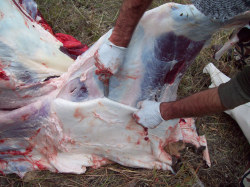
The idea is to avoid cutting the meat or the hide while skinning an elk, deer, or other big game (except for "lengthwise" and "around" cuts). A lot of people start along the spine, but if you need to gut it to cool it quicker, start on the stomach.
After making a start with your knife, pull the skin away from the meat with your hand while slicing parallel to the meat with your knife. You will actually be cutting through the white membranous layer that begins to stretch between the meat and hide as you pull on it.
The key point is that you are cutting the white stuff, not the meat or hide. A skinning knife makes it easier to avoid poking the tip through the hide or into the muscle, but any sharp knife will do.
If you see that you are cutting into meat, angle the blade toward the hide. If you see that you are cutting through the hide, angle the knife a little toward the meat. In some places, you might be able to pull the skin away without making much, if any, cutting motion. Other areas will be tighter and require more patience, care, and shorter cuts.
"Lengthwise" and "Around" Cuts
While skinning elk, consider that everything on the animal is basically “around”. That is, the skin goes all the way around everything: torso, neck and legs. You always have to make a “lengthwise” (perpendicular, or long) cut and then an “around” cut on these round parts.
For lengthwise cuts, cut with the direction of the hair to avoid dropping hair on the meat. You make the first “lengthwise” cut along the stomach or spine. You’ll need one along each leg that meets the first cut. (If you're caping, you'll need to do it this way.)
Then you will need four “around” cuts at the bottom of each leg and one below the head on the neck, or way back on the ribs for caping. Unwrap the whole carcass using the method of separating hide from meat by pulling and slicing the white stuff between them.
Around the butt you’ll have to work at it a little, because the hide goes around this and that curve. You an easily cut off the tail, using a saw or knife, and leave it attached to the hide.
Keeping Hair and Dirt off Meat
When skinning elk or other big game keep in mind that every time you cut through the hide, you will cut hair. The hair falls free and can easily land on meat, potentially tainting the flavor. Avoid it by moving your knife away from the meat as you cut through hide and cut with the hair.
Always try to make cuts through hide from the meat side outward, as much as possible, to avoid getting hair on the meat. That is, cut with the knife blade pointing away from the meat outward (like you do when making the gutting cut). Again, cut with the direction of the hair.
If you make a cut through hide that is above exposed meat, especially while skinning elk that is hanging, hair will drop on your exposed meat below. Loose hair heads for moist meat like a magnet.
If a bull has been wallowing, the mud is usually dry and now the hide will be covered with thick dirt, which readily falls on your meat if you're not careful. I skinned a 5 X 6 in September of 2009 that was filthy. I used several pairs of latex gloves because the dirt covered the glove whenever I pulled on the hide.
Any hair or dirt on the meat can easily be removed before freezer wrapping by cutting off the white membrane on the outside of the muscle. It won't rinse of with water. It's too sticky. Just peel off that membrane and it's clean!
No Need to Carry a Heavy Hide
Incidentally, I stopped carrying heavy hides a long time ago, when packing meat out of the woods.
If you want to take it home, roll it up lengthwise, hair out. Tie it in at least three spots to keep it from unrolling. Then drag it behind you on the ground with a long enough rope to keep it away from your heels. It slides easily on the ground.
Now you’re ready to debone it or cut it up or take it to the butcher shop for processing. Consider cutting and wrapping it yourself. It’s not that difficult. Click here to see the Hunter's Meat Map that you can follow generally. You don't have to do it perfectly!
Here is the gutless field dressing and quartering Video provided by Dax McCarty of Wagonhound Outfitters:
Please subscribe to or our Quick Elk Hunting Tips and Updates newsletter or to an RSS feed (see left column for both) to be alerted whenever new information is added to the site.
We'd appreciate it if you would "Like" us on Facebook, or share this site with others.
Search this site here:


Comments:
Hector, TX: "Wow, that was fast! It's very pleasant to see your sincere spirit of service and customer care... You are doing way more than selling products to customers like me...we are getting tremendous value from all you do with your site and your business."
Tim, AZ: "This morning, she was 145# on the hook. I definitely owe some of my success to your website and your products. Thanks again!"
Jesse, NM: "I just wanted to thank you for taking the time and energy
in creating such an amazing and helpful website. As a new hunter, this provides
an excellent guide to approaching elk hunting. I just wanted to thank you for
sharing such a wealth of knowledge, and giving us new hunters a fighting chance
of filling a tag. You guys are amazing!!!"
Skip, (Tucson, AZ) "Your Elk Hunting Tips Web Site is the best, most helpful
one I have ever seen. I read and profit more than I can tell you. I just wanted
to tell you THANKS!
P. Scott, (BC 2016) "I would like to thank my hunting partner for the great company & this website for the wealth of information that I have gleaned & also the gear bought as every bit of info etc. is required to harvest one of these regal animals."
Thomas (OR), "Reading your tips has helped me to formulate a hopefully
positive and safe game plan for the 2014 elk season!"
Travis (WI), "I just wanted to say thank you for your site, and helpful emails! I got several useful tips from you, and your site. ...got to put the smack down on my first elk, a beautiful New Mexico 300 class bull."
Tristan, Superior, CO: "I feel like I could go on forever here, I just get so excited talking about elk and I don't know many other hunters… Thanks again for the gear, and the website. I have found it to be very useful and enlightening.
Jordan, MT: "Your website is a great help! I wanted to personally thank you for the great tips on hunting elk. I am extremely excited for this elk rifle season as its my first. I wish you luck during your hunts and God bless!"
Shop Our Store
Newsletter Opt-in:
"I just get so excited talking about elk.." ~Tristan, CO
Search This Site Here:
Hunting Gear Reviews
ASAT CamoElkNut Outdoor Prod.
Bugling Bull Game Calls
HECS Stealthscreen
Montana Decoy
StringSling Bow Sling
Skull Hookers
Safari Sling Rifle Sling
Clip-Shot Mini Camera Mount
ASAT Camo
Bugling Bull
Game Calls
ElkNut Productions
Free Shipping on
ElkNut Products Here
HECS Stealthscreen:
A New Type of Concealment!
$199.99,
Including U.S. Shipping
Montana Decoy Elk/Deer
Available Here!
The StringSling:
Best Bow Sling Design!
$29.95, Including U.S. Shipping
Clip-Shot: 1 oz. Camera Mount
Skull Hookers
$34.99 & 59.99 Free U.S. Shipping!
The Safari Sling:
Best Rifle Sling Design!
Share your elk hunting pictures and stories on our
Facebook Page!
Forum Topic Discussions:
How often should I use my cow call?, I am new to the sport of bow hunting elk and my question is how often should I use my cow calls?
295 yard kill with a Kimber Montana 325 WSM, by Don from Dallas: My ELk did not even twitch once. He was dead when he hit the ground.
325 WSM is worth considering, Palmer Lake,CO: I believe that the .325 WSM is the ultimate elk caliber...
30-30 for Elk? : I have a 30 30 with 170 grain round nose bullet. Will this work to shoot an elk ?
(More comments about Best Elk Rifle below)
Submissions
Unique Elk Talk by Idaho Steve (Hailey, Id ), In the middle of the night, a herd of elk came traveling through the drainage and right past my tent...
Smelly Elk Areas? by Jimmy (New Mexico), I've come across many areas that just stink of elk, literally. I have heard two somewhat contradictory stories...
DIY Gear List Must Have's! by Craig (Florida) "Here are some of the items I use on my DIY hunts in the CO backcountry..."
Elk and Deer Hunting and Mountain Bikes, by Skip Shepherd (Tucson, AZ)~ At 67 I am thinking a lot about investing in a mountain bike to get back into remote areas...
Solo archery hunting -- tips for calling/set up?, by Idaho Steve (Hailey, ID )~ I hunt by myself a lot...I'd love to hear your thoughts on strategic set-ups when solo hunting and calling.
Non- Lead Bullets for Elk?, by Dave, Elk Hunting Tips.Net (Garrison, MT)~ What do you ballistics guys think about the use of non-lead bullets for elk? According to this story...
Rage Broadheads by Chris, ...my buddy gave me a rage practice tip and when I shot it you could not pick out the broadhead from the field points. I was sold...
Recent Submissions:
Finally filled the freezer..., Colorado Rockies~ "I was bummed when I got to the property and no elk, nor any hoof prints in the snow. ...I pulled each of the elk into shade then started gutting..."
Wounded Veteran Elk hunts, by Joshua FL), I am a disabled veteran of Operation Iraqi Freedom and have always dreamed of hunting elk. I am posting this to see if anyone would know of any elk hunts free to disabled vets....
First Elk with a Bow, by Ryan H. (Colorado), ...Finally after many years of hunting with a bow "I got er did"!
First Elk!, by Tater (Sheridan, Arkansas) I took the advice I received from this website and was successful…I wanted to Thank You and Your Forum and the folks that share on here for the knowledge and information that helped me find an elk I was quite happy with.
Any success in Unit 14?, by: Dave (MI), "I'm planning on doing a DIY in Unit 14 for 2012..."
Bugle in Herd bulls, by Swiltbank (Az) The key to calling in a herd bull is to get into his bedding grounds and threaten his herd. Start off sounding like…
Best Rifle Caliber?, by Buglemup (Superior, MT), "I've been reading what people have been writing about rifle calibers and here is what 16 years of guiding elk has taught me."
7mm Remington Magnum, by Dean (Helena, MT. USA) I use my Liberty Ruger M77, 7mm Rem. Mag. for antelope, deer, elk... Comment: "What do you guys think about the idea of hunting elk with a 270? I also know a guy who kills elk with a 243."
338 Marlin Express, "Light, fast shooting, hard hitting, manageable recoil, and for a lever gun - very accurate."
Guns I like for Elk, by Mountain Walker (Kootenays east B.C. Canada),"I think the gun you shoot Elk with should be one you shoot a lot with... "
.35 Remington, by Bill Smith "...my .35 Rem appears to have dropped a medium deer flawlessly, but I now have serious doubts as to its capability to take an elk."
Where to hunt in Az unit 3B?, by Cliffjumper (Tucson, Az) ~ I got a late bull muzzle loader hunt in Arizona unit 3b. Does anyone know how to hunt bulls in the late season?...
First time elk hunter hunting Arizona unit 6A , by Rob Marchio (Omaha, Ne)~ I'm a first time elk hunter hunting Arizona's unit 6A. I'm planning on staying in the Pine Grove campground...
Help needed for 1st DIY Hunt w/Son, by Patrick (Parker, CO), "I was looking for some advice on my 1st DIY hunt for 2014 in CO with my 13 yr old son. I have countless hrs going over stats, topo maps & Google Earth"
Elk Hunting Colorado in 2013, By William (Midland, TX) "I am planning an elk hunt next year in Colorado and I wanted to know if hunting Gunnison National Forest..."
Unit 60 Elk 4th Rifle Season Nov 13-17 Either Sex 2013, By Chester "...Any general advice about the unit would be appreciated!"
Elk Hunting Idaho Unit 8 8A 11, This is my first year seriously trying to track down some elk. Is there anyone that has hunted in any of these units and can give me some friendly advice? Mitchell, Moscow Idaho
Elk Hunting Pocatello by Cameron (Pocatello) Where is the best place to elk hunt around Pocatello, Idaho? I'm a student at ISU and I'm looking for somewhere around here to hunt next season.
How is the elk hunting in unit 30A in Idaho?, by Terry (Richland Center, WI) Has anyone archery elk hunted in unit 30A in Idaho? What can you tell me about the area?
Hunting in Western Montana, by Mike A. (Alabama)
I did not draw a tag for Missouri breaks where I have hunted in the past. Having to start over and try western Montana.
New Mexico Unit 49, by Silas (Los Alamos, NM)
If anyone has tips on areas to start scouting, I'd really appreciate it.
First Elk Hunt First Elk Hunt, by Big "R" (NM)
I finally got drawn for a late elk hunt in Unit 28, north of Road 506 and south of the boundary line of the Lincoln National Forest...
Cow elk in Nevada's unit 222:
"Any good places known in unit 222?"
Northeast Nevada Early Elk hunt, by John (Carson City,NV)
"Any suggestions on what areas I may see some signs of elk?"
Retired USMC MSgt Needs Advice, by Ken Wing USMCRET (Bealeton, Va)
Popcorn VenisonPopcorn Venison with Maple Syrup?
Elk or Venison Steaks Grilled to Perfection Here's how to turn them into steakhouse steaks!
Spice-Crusted Grilled Venison Roast Recipe This Spice-Crusted, Grilled Venison Roast recipe works great for any red meat roasts, including elk, deer or beef roast...
Corned Elk Recipe You can easily make corned venison and elk, moose or corned beef from these instructions...
New! Comments
Leave a comment in the box below.